The Anti-Aging Diet, Fact-Checked: What the Research Actually Shows
We re-checked every claim in this article against the primary literature. Here is what the research on longevity, leafy greens, omega-3 and Urolithin A actually supports — and what it does not.
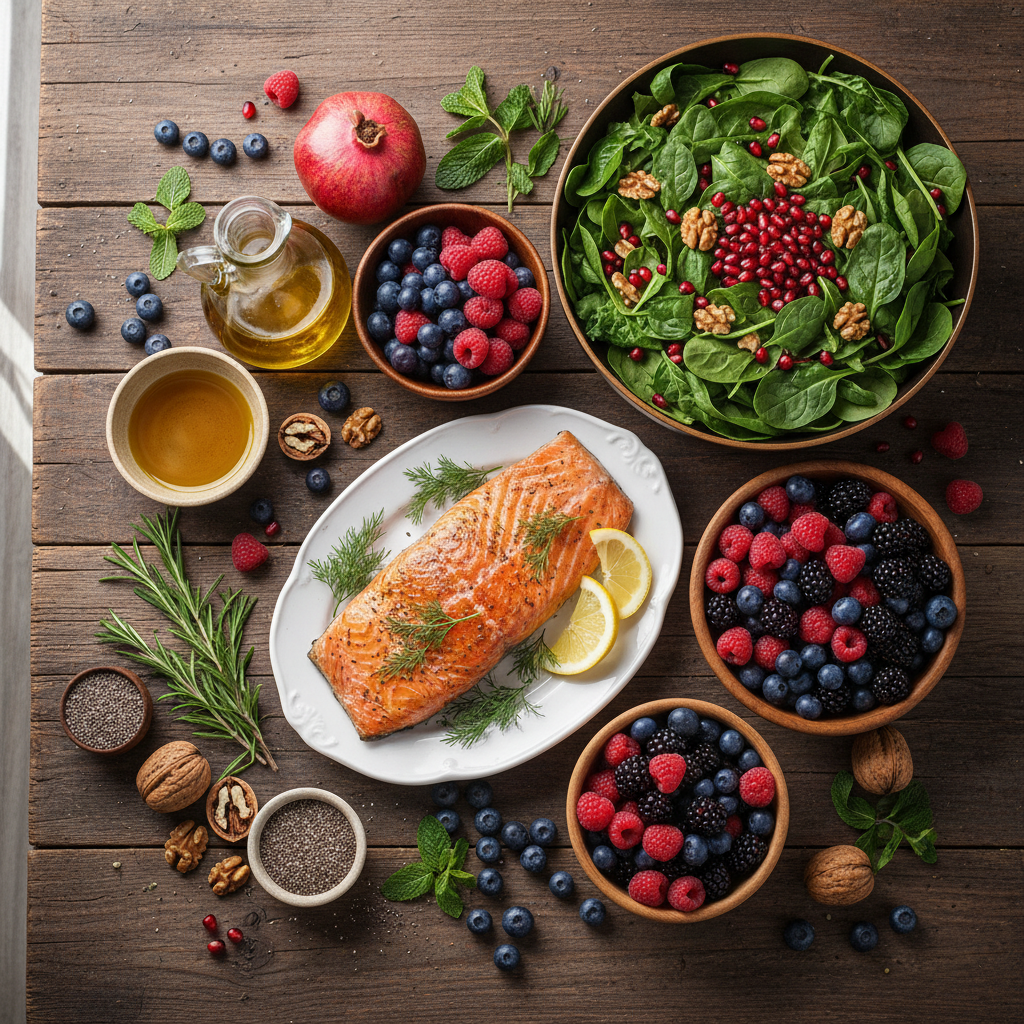
Longevity content has a pattern problem. A real study produces a modest, conditional finding. The finding travels through a podcast, a newsletter and a dozen articles. By the end it has lost its conditions, gained a number that was never in the paper, and turned into a promise.
We went back to the original papers behind the claims in this article. Some held up. Some did not. Here is what is left standing.
The one number worth knowing
In 2022, researchers at the University of Bergen published a modelling study in PLoS Medicine estimating how life expectancy changes when someone moves from a typical Western diet to an optimised one.
The headline figure is real: 10.7 years for women, 13.0 years for men. But it carries a condition that almost never survives the retelling — it assumes the change starts at age 20 and is sustained.
| Age when the change starts | Women | Men |
|---|---|---|
| 20 | +10.7 years | +13.0 years |
| 60 | +8.0 years | +8.8 years |
| 80 | +3.4 years | +3.4 years |
Two things are worth holding on to. First: eight years from age 60 is still a striking number. You have not missed the window. Second: this is a model, not a measurement. The authors state plainly that it is "not meant as individualized forecasting," and they rate the underlying evidence as moderate.
Which foods carried the most weight
The same study broke the total down by food group. These contributed most (years gained, women / men):
- Legumes — 2.2 / 2.5
- Whole grains — 2.0 / 2.3
- Nuts — 1.7 / 2.0
- Less red meat — 1.6 / 1.9
- Less processed meat — 1.6 / 1.9
Notice what is not at the top. No berry, no powder, no exotic extract. The three largest contributors are lentils, oats and a handful of walnuts.
Leafy greens: one serving, not five
You will often read "five servings of leafy greens a day." The study behind that line says something different.
Morris and colleagues at Rush University, published in Neurology in 2018, followed 960 people aged 58 to 99 for an average of 4.7 years. The group with the slowest cognitive decline ate a median of 1.3 servings of green leafy vegetables per day. The authors describe it as "approximately 1 serving per day." They put the size of the difference at roughly the equivalent of being 11 years younger.
They also tested the individual components. Vitamin K, lutein, folate, alpha-tocopherol, nitrate and kaempferol each showed an association on their own. Beta-carotene did not reach significance.
This is an observational study, so it shows an association rather than cause and effect. But the practical message is easier than the myth: one real serving a day.
Omega-3 and telomeres: what was actually measured
Farzaneh-Far and colleagues (JAMA, 2010) measured telomere length in 608 outpatients twice, five years apart.
Those with the lowest blood levels of DHA and EPA showed the fastest telomere shortening; those with the highest showed the slowest. Each standard deviation of increase was associated with 32% lower odds of shortening.
Two caveats the popular version drops. The finding is slower shortening, not longer telomeres. And every participant had stable coronary artery disease — whether the same holds in healthy people was not tested here.
The pomegranate story, told properly
Pomegranate usually sits at the top of longevity lists because of Urolithin A. It is worth walking through this one slowly, because it shows exactly how a real result becomes a wrong headline.
The human trial is Singh and colleagues, Cell Reports Medicine, 2022: randomised, placebo-controlled, four months, middle-aged adults.
What it found: muscle strength improved by about 12%, and markers of mitochondrial function improved.
What it did not find: it missed its primary endpoint, peak power output. That is stated in the paper's own abstract.
Three further things belong in any honest summary:
- The trial used Mitopure, a supplement — not pomegranate.
- The study was run by Amazentis SA, the company that sells Mitopure. Seven of the nine authors are employed there.
- Urolithin A is not in the fruit. It is produced when gut bacteria break down ellagitannins from pomegranate — and not everyone carries the bacteria that do it. Eating pomegranate does not reliably put Urolithin A in your blood.
None of this makes pomegranate a bad food. It makes "reverses immune ageing" a claim the evidence does not carry.
Where the evidence is thinner than the enthusiasm
Honest reporting means naming what we could not verify.
- Berries and brain inflammation. Widely repeated; not demonstrated in humans at the level the claims imply.
- Curcumin. Poorly absorbed from the gut, and the link to biological ageing is not established.
- Fermented foods. The gut microbiome clearly matters. The specific line from a jar of kimchi to how your skin looks is not established.
We have kept these on the page rather than quietly deleting them. "We do not know yet" is a legitimate answer, and you deserve to know which parts are which.
What this leaves you with
Not a shopping list of exotics. Something more boring and much better supported.
More legumes. More whole grains. A handful of nuts. A real serving of leafy greens. Oily fish. Less red and processed meat. Olive oil rather than refined fats.
That is the pattern the strongest evidence points to, and it is what Up-Food builds a week of meals around.
Frequently Asked Questions
What is the best food for anti-aging?
There is no single one. In the largest modelling study to date, the food groups contributing most to projected life expectancy were legumes, whole grains and nuts — alongside eating less red and processed meat.
Can diet really reverse aging?
No. Chronological age does not run backwards. What the research supports is more modest: sustained dietary change is associated with more years lived, and the earlier it starts, the larger the projected gain.
Is it too late if I am over 50?
No. The same model estimates roughly eight additional years for a change beginning at 60.
How many servings of leafy greens should I eat?
About one a day is the amount at which the association was observed. Five is a misreading of the research.
Does eating pomegranate give me Urolithin A?
Not reliably. Urolithin A is made by gut bacteria from compounds in the fruit, and not everyone has those bacteria. The clinical trial people cite used a supplement, not the fruit.
Updated 18 September 2026. This article was revised after we re-checked every claim in it against the primary literature. Several statements were corrected — including the leafy-green serving figure and the description of the Urolithin A trial. We publish what the sources support, and we say so when we got something wrong.
Sources
- Fadnes LT, Økland JM, Haaland ØA, Johansson KA. Estimating impact of food choices on life expectancy: A modeling study. PLoS Medicine 2022;19(2):e1003889. https://doi.org/10.1371/journal.pmed.1003889
- Morris MC, Wang Y, Barnes LL, Bennett DA, Dawson-Hughes B, Booth SL. Nutrients and bioactives in green leafy vegetables and cognitive decline: Prospective study. Neurology 2018;90(3):e214–e222. https://doi.org/10.1212/WNL.0000000000004815
- Farzaneh-Far R, Lin J, Epel ES, Harris WS, Blackburn EH, Whooley MA. Association of marine omega-3 fatty acid levels with telomeric aging in patients with coronary heart disease. JAMA 2010;303(3):250–257. https://doi.org/10.1001/jama.2009.2008
- Singh A, D'Amico D, Andreux PA, et al. Urolithin A improves muscle strength, exercise performance, and biomarkers of mitochondrial health in a randomized trial in middle-aged adults. Cell Reports Medicine 2022;3(5):100633. https://doi.org/10.1016/j.xcrm.2022.100633
This article describes published research. It is not medical advice and not a recommendation to take any supplement. If you are considering supplements, discuss it with your doctor and have the relevant blood values measured.
What is actually missing from your week?
Up-Food calculates over 30 nutrients from the real ingredient amounts in your weekly plan – based on verified USDA data, not estimates.
See the weekly plan